
Who hasn’t stood there, in front of someone who holds power, possibly direct power over you, your job, your relationship, and you just told them, “No.”
Inevitably, they look at you as if they’re not sure what sound vibrations just managed to cross into their ear canal. “What did you say?”
More firmly, you repeat yourself, “No.”
Two letters. One syllable. A tiny little word. Yet, it is arguably the heaviest, most fundamentally disruptive word in the English language. From the moment we first learn to speak, the word “no” is treated less as an assertion of personal autonomy and more as an act of dangerous rebellion. We are raised within systems built entirely on the expectation of obedience. We don’t say no. Ever. To anyone. It’s not nice.
Empowerment Lost
The authoritarians in our early lives establish the baseline: parents demand compliance, teachers enforce order in the classroom, and preachers prescribe spiritual surrender. As we age, the cast of authoritarians simply changes labels: employers, institutional leaders, and government officials, all demanding societal conformity. Together, they have ingrained in us a deeply harmful lesson: that saying “no” to them is not just disrespectful, but fundamentally unacceptable. We are conditioned to believe that to belong, we must be agreeable. While our person changed, often dramatically, we were told our behavior had to remain consistent and polite. To be safe, we must comply.
This lifelong conditioning comes at an incalculable cost. In stripping us of our capacity for refusal, these systems learn to rely on our quiet, pervasive compliance. When we are taught that “no” is forbidden, we default to a self-preservation tactic of silence. However, in failing to say no, people around us have mistaken our lack of dissent for a consent that we never actually offered. Silence is far too often harvested as agreement. We are all familiar with the phrase, “you have the right to remain silent.” But remaining silent is not just a passive defense mechanism. Silence leads to abuse, to trauma, and to death.
We have seen exactly what happens when we are silent, hoping the storm will pass or that the authority figure will organically realize the problem of their behavior: our boundaries are completely ignored, our rights are systematically eroded, and too often, our very bodies are trampled under the weight of someone else’s entitlement. Silence leaves a vacuum that authoritarians gladly fill with their own agendas. Silence results in too many Jane Does on too many police forms.
The Mechanics of Refusal
To survive, we must deconstruct the abusive expectations of patriarchy and dismantle the conditioning of our childhoods. We must remember that we have the absolute right to say “No.” More than that, we have the right to say it loudly, projecting it clearly to anyone who needs to hear it. This right does not vanish in the presence of a title, a badge, a degree, or a familial bond. We can and must say it to parents who overstep, to partners who push limits, to bosses who demand our exhaustion, and to any other person in an authoritative position. Reclaiming “no” is how we disrupt their assumption of unlimited access to our lives.
Furthermore, we have the right to say it without offering a single word of additional explanation. Authoritarians thrive on the demand for justification; they ask “why?” so they can dismantle our reasoning, negotiate our boundaries, or invalidate our feelings. We must reject the premise that our refusal requires a defense attorney.
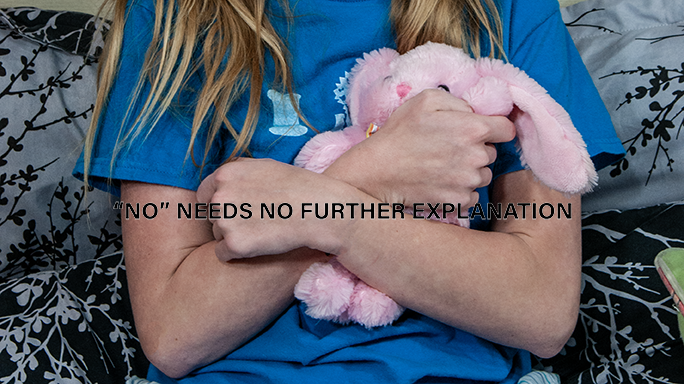
“No.” is a full sentence. It stands entirely on its own. It requires no commas, no conjunctions, and no apologies. Once it is spoken, the conversation is over. We owe no one any further discourse, debate, or defense of our personal boundaries. Our discomfort, our lack of capacity, or our simple lack of desire is all the justification required. The late First Lady of the United States, Nancy Reagan, made it a slogan: “Just say no.”
The Absolute Fluidity of Consent
Crucially, the power of “no” is absolute and highly fluid. It is not bound by time, nor is it trapped by previous agreements or past compliance. No means no, even if two seconds ago we said yes. Consent is not a binding contract permanently signed in ink; it is a continuously renewable, ongoing state of being. The exact moment a situation no longer feels safe, comfortable, or acceptable, any previous “yes” evaporates entirely. The right to change our minds is a fundamental human right. Revoking consent is an act of immediate self-worth, and the swift application of “no” is the mechanism by which we enforce that worth. This is why the church has its own Consent Policy. No means no, without exception.
In a world that relentlessly demands our compliance, our energy, and our physical space, the refusal to comply is an act of profound, radical self-preservation. “No” establishes the perimeter of our personhood. This is the line drawn in the sand that stops abuses of power in their tracks. This little word protects our mental health, our emotional well-being, and our physical safety.
Quite literally, saying “no” saves lives. Reclaiming this two-letter word from the authoritarians who tried to steal it from us is not an act of hostility. It is the ultimate act of taking back ownership of ourselves.
Empowerment and Partnership
I am not naive. I know too well that not everyone listens when we say no. My stomach turns every time another news story relates yet another instance of sexual abuse where someone’s “no” was completely ignored. Then, not only is the boundary obliterated by the abuser, but people rush to justify their actions. This has to stop.
The immediate answer is partnership: people who will always, without needing any explanation, come to the defense of the abused. We are currently experiencing a movement of “I Am Jane Doe” in light of an absolutely horrific event on a college campus. We have to ask ourselves: why did it take two years for this Jane Doe to receive that support?
Why wasn’t it there in the first place? Why did it not exist within the police department that failed to act on the initial report? Why was it not present in the district attorney’s office before they decided to not press charges? Why did she have to lose two horrible years of her life before crowds of people came rushing forward?
Empowerment Starts At The Beginning
The long-term answer is education, starting with how we talk to children. We teach with every word we say to them. Every parent understands the emotional challenge of a toddler who has learned that the word “no” has power. Yet, it is not our job to crush that autonomy. Partnership begins right there, even if the child is covered in poop wrapped in toilet paper (yeah, that happened). Right there is where we teach about respecting boundaries, that “no” is absolute, and that people who are your partners don’t force your actions, but help you find answers and alternatives.
The time has come for Western Society, all of it, to learn the radical empowerment of no. Corporations devastating our environment need to be told no. Governments, especially presidents and militaries, trampling the basic rights of human beings, need to be told no. HR departments need to regain an understanding of the concept that “no” is an employee right. Husbands. Wives. Parents. Siblings. Random people on the street. In every language around the world, one word carries radical power.
No.

Leave a Reply
You must be logged in to post a comment.